
Keywords
Cultural and creative organizations
intellectual capital
business models
archaeology
How to Cite
Accepted 2025-11-03
Published 2025-12-31
Abstract
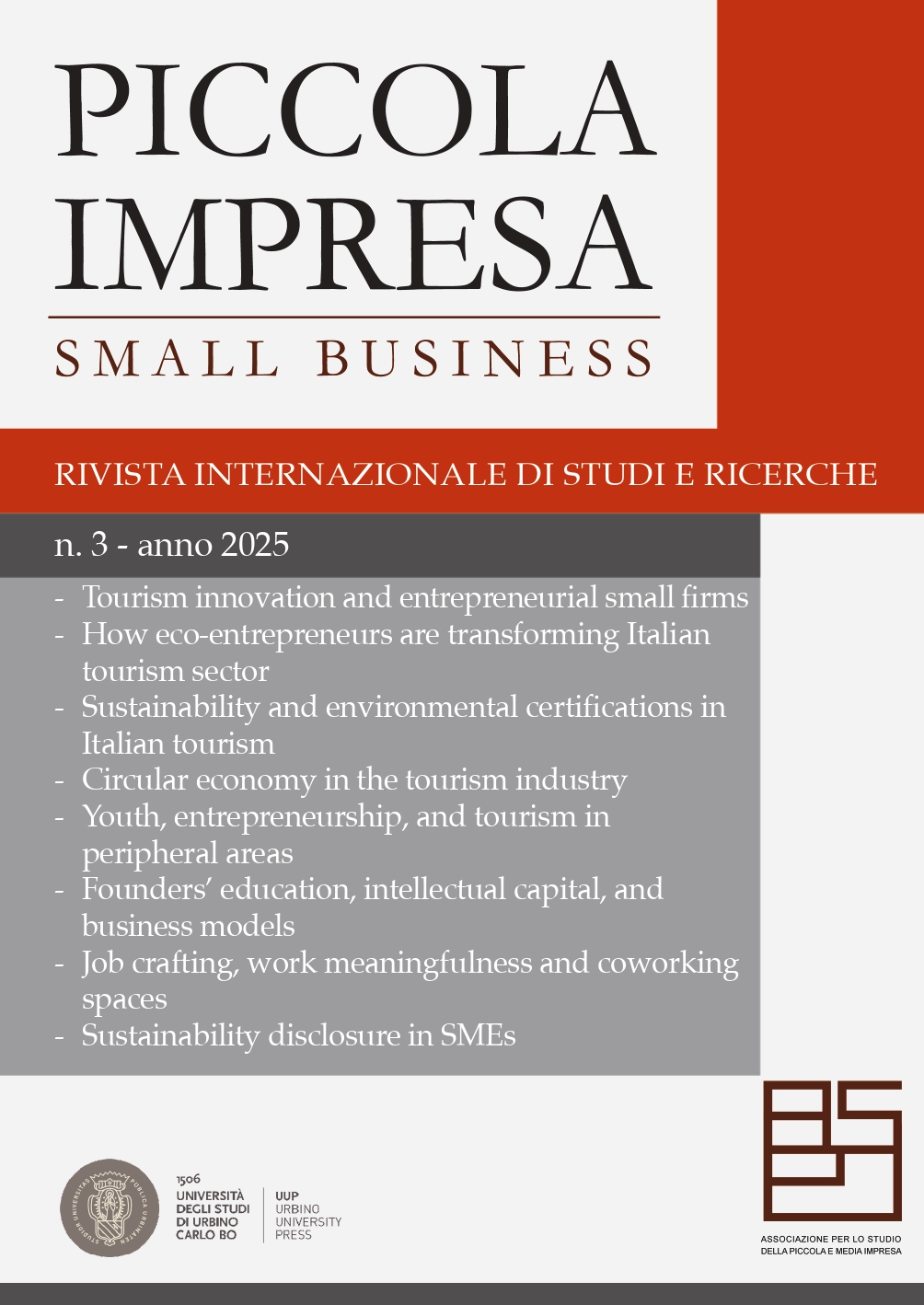
Purpose: This work investigates how the educational background of founders of cultural and creative organizations affects the relationship between intellectual capital and business models.
Design/methodology/approach: A narrative literature review revealed a lack of studies in arts and humanities focusing on the relationship between intellectual capital and business models. The empirical investigation involved three case studies of three SMEs operating in the archaeological field, demonstrating that educational background significantly influences these relationships.
Findings: The analysis identifies four key factors: creativity, network relationships, cross-disciplinary competencies, and adaptability to new technologies. Firstly, creativity serves as a driving force in the early stages of a start-up. Secondly, strong network relationships can provide access to external knowledge and resources, enhancing key assets. Thirdly, collaboration with partners enables organizations to adapt to evolving conditions, such as technological advancements, impacting both human and structural capital. Lastly, cross-disciplinary competencies allow for a multidisciplinary approach to problem-solving, fostering internal skill development. The findings suggest that educational background equips SMEs founders with the tools to create a compelling value proposition by leveraging cultural and creative organizations intellectual capital.
Practical and social implications: Higher education institutions can encourage entrepreneurship by involving students in knowledge-transfer projects, like academic spin-offs.
Originality of the study: The study provides insights into four directions associated with the effects of cultural and creative organizations founders educational background on the relationships between intellectual capital and business model.
References
Amaratunga, D., Baldry, D., Sarshar, M., & Newton, R. (2002). Quantitative and qualitative research in the built environment: application of “mixed” research approach. Work Study, 51(1), 17–31. https://doi.org/10.1108/00438020210415488
Amit, R., & Schoemaker, P. J. H. (1993). Strategic assets and organizational rent. Strategic Management Journal, 14(1), 33–46. https://doi.org/10.1002/smj.4250140105
Amit, R., & Zott, C. (2001). Value creation in E-business. Strategic Management Journal, 22(6–7), 493–520. https://doi.org/10.1002/smj.187
Amit, R., & Zott, C. (2015). Crafting Business Architecture: the Antecedents of Business Model Design. Strategic Entrepreneurship Journal, 9(4), 331–350. https://doi.org/10.1002/sej.1200
Argyris, C., & Schön, D. (1996). Organizational Learning: Theory, Method, and Practice. Addision-Wesley.
Baden-Fuller, C., & Mangematin, V. (2013). Business models: A challenging agenda. Strategic Organization, 11(4), 418–427. https://doi.org/10.1177/1476127013510112
Baima, G., Forliano, C., Santoro, G., & Vrontis, D. (2020). Intellectual capital and business model: a systematic literature review to explore their linkages. Journal of Intellectual Capital, ahead-of-p(ahead-of-print). https://doi.org/10.1108/JIC-02-2020-0055
Barnabè, F., Busco, C., & Hoque, Z. (2013). The causal relationships between performance drivers and outcomes. Http://Dx.Doi.Org/10.1108/18325911211273518. https://doi.org/3150080405
Baron, J. N., Hannan, M. T., & Burton, M. D. (1999). Building the Iron Cage: Determinants of Managerial Intensity in the Early Years of Organizations. Source, 64(4), 527–547.
Benneworth, P., & Jongbloed, B. (2009). Who matters to universities? A stakeholder perspective on humanities, arts and social sciences valorisation. https://doi.org/10.1007/s10734-009-9265-2
Bilton, C. (2007). Management and creativity: from creative industries to creative management. Blackwell Publishing.
Bini, L., Dainelli, F., & Giunta, F. (2016). Business model disclosure in the Strategic Report. Journal of Intellectual Capital, 17(1), 83–102. https://doi.org/10.1108/JIC-09-2015-0076
Bowman, C., & Ambrosini, V. (2000). Value Creation Versus Value Capture: Towards a Coherent Definition of Value in Strategy. British Journal of Management, 11(1), 1–15. https://doi.org/10.1111/1467-8551.00147
Breuer, W., Knetsch, A., & Salzmann, A. J. (2018). What Does It Mean When Managers Talk About Trust? SSRN Electronic Journal. https://doi.org/10.2139/SSRN.3204621
Bridgstock, R., & Cunningham, S. (2016). Creative labour and graduate outcomes: implications for higher education and cultural policy. International Journal of Cultural Policy, 22(1), 10–26. https://doi.org/10.1080/10286632.2015.1101086
Campos, S., Dias, J. G., Teixeira, M. S., & Correia, R. J. (2022). The link between intellectual capital and business performance: a mediation chain approach. Journal of Intellectual Capital, 23(2), 401–419. https://doi.org/10.1108/JIC-12-2019-0302
Carlile, P. R. (2004). Transferring, Translating, and Transforming: An Integrative Framework for Managing Knowledge Across Boundaries. Organization Science, 15(5), 555–568. https://doi.org/10.1287/orsc.1040.0094
Casadesus-Masanell, R., & Zhu, F. (2010). Strategies to Fight Ad-Sponsored Rivals. Management Science, 56(9), 1484–1499.
Chandler, G. N., & Hanks, S. H. (1994). Market attractiveness, resource-based capabilities, venture strategies, and venture performance. Journal of Business Venturing, 9(4), 331–349. https://doi.org/10.1016/0883-9026(94)90011-6
Chesbrough, H. (2002). The role of the business model in capturing value from innovation: evidence from Xerox Corporation’s technology spin-off companies. Industrial and Corporate Change, 11(3), 529–555. https://doi.org/10.1093/icc/11.3.529
Chesbrough, H. (2010). Business Model Innovation: Opportunities and Barriers. Long Range Planning, 43(2–3), 354–363. https://doi.org/10.1016/j.lrp.2009.07.010
Chesbrough, H. (2019). Open Innovation in the Twenty-First Century. In Open Innovation Results (pp. 28–50). Oxford University Press. https://doi.org/10.1093/oso/9780198841906.003.0003
Comunian, R., & Gilmore, A. (2015). Beyond the Creative Campus. In Reflections on the evolving relationship between higher education and the creative economy. King’s College London.
Corvello, V., Cimino, A., & Felicetti, A. M. (2023). Building start-up acceleration capability: A dynamic capability framework for collaboration with start-ups. Journal of Open Innovation: Technology, Market, and Complexity, 9(3), 100104. https://doi.org/10.1016/j.joitmc.2023.100104
Cosenz, F., & Bivona, E. (2021a). Fostering growth patterns of SMEs through business model innovation. A tailored dynamic business modelling approach. Journal of Business Research, 130, 658–669. https://doi.org/10.1016/j.jbusres.2020.03.003
Cosenz, F., & Bivona, E. (2021b). Fostering growth patterns of SMEs through business model innovation. A tailored dynamic business modelling approach. Journal of Business Research, 130, 658–669. https://doi.org/10.1016/j.jbusres.2020.03.003
Cosenz, F., & Noto, G. (2018). A dynamic business modelling approach to design and experiment new business venture strategies. Long Range Planning, 51(1), 127–140. https://doi.org/10.1016/j.lrp.2017.07.001
Cremin, L. A. (1976). Public Education. Basic Books.
Crupi, A., Cesaroni, F., & Di Minin, A. (2021). Understanding the impact of intellectual capital on entrepreneurship: a literature review. Journal of Intellectual Capital, 22(3), 528–559. https://doi.org/10.1108/JIC-02-2020-0054
Curran, J., & Blackburn, R. (2001). Researching the Small Enterprise. SAGE Publications, Ltd. https://doi.org/10.4135/9781849209847
D’Amato, A. (2021). Does intellectual capital impact firms’ capital structure? Exploring the role of firm risk and profitability. Managerial Finance, 47(9), 1337–1356. https://doi.org/10.1108/MF-02-2020-0089
Dimitropoulou, A., Giotopoulos, I., Protogerou, A., & Tsakanikas, A. (2023). Does the innovativeness of creative firms help their business clients to innovate? The Journal of Technology Transfer, 48(1), 1–32. https://doi.org/10.1007/s10961-021-09901-1
DMCS UK. (2001). Creative Industries Mapping 2001.
Edvinsson, L., & Malone, M. S. (1997a). Intellectual Capital: Realizing Your Company’s True Value by Finding Its Hidden Brainpower. HarperCollins.
Edvinsson, L., & Malone, M. S. (1997b). Intellectual Capital: Realizing Your Company’s True Value by Finding Its Hidden Brainpower. HarperCollins.
Eisenhardt, K. M. (1989). Building Theories from Case Study Research. The Academy of Management Review, 14(4), 532–550. https://doi.org/10.2307/258557
Elia, G., & Lerro, A. (2020). Linking Business Model Mapping and Innovation with Intellectual Capital in Technological Start-Ups BT - Innovative Entrepreneurship in Action: From High-Tech to Digital Entrepreneurship (G. Passiante, Ed.; pp. 37–53). Springer International Publishing. https://doi.org/10.1007/978-3-030-42538-8_4
Elia, G., Lerro, A., Passiante, G., & Schiuma, G. (2017). An Intellectual Capital perspective for Business Model Innovation in technology-intensive industries: empirical evidences from Italian spin-offs. Knowledge Management Research & Practice, 15(2), 155–168. https://doi.org/10.1057/s41275-017-0052-z
Ensley, M. D., & Hmieleski, K. M. (2005). A comparative study of new venture top management team composition, dynamics and performance between university-based and independent start-ups. Research Policy, 34(7), 1091–1105. https://doi.org/10.1016/J.RESPOL.2005.05.008
Ferreira, A., Franco, M., & Haase, H. (2022). Strategic alliances and development of intellectual capital: a study of technology-based SMEs. International Journal of Organizational Analysis, 30(6), 1644–1671. https://doi.org/10.1108/IJOA-10-2020-2440
Gassmann, O., & Frankenberger, K. (2014). The Business Model Navigator: 55 Models That Will Revolutionise Your Business. Pearson Education.
Gilmore, A., & Comunian, R. (2016). Beyond the campus: higher education, cultural policy and the creative economy. International Journal of Cultural Policy, 22(1), 1–9. https://doi.org/10.1080/10286632.2015.1101089
Girotra, K., & Netessine, S. (2013). OM Forum —Business Model Innovation for Sustainability. Manufacturing & Service Operations Management, 15(4), 537–544. https://doi.org/10.1287/msom.2013.0451
Gross, S., Stelzl, K., Grisold, T., Mendling, J., Röglinger, M., & vom Brocke, J. (2021). The Business Process Design Space for exploring process redesign alternatives. Business Process Management Journal, 27(8), 25–56. https://doi.org/10.1108/BPMJ-03-2020-0116
Guthrie, J., Ricceri, F., & Dumay, J. (2012). Reflections and projections: A decade of Intellectual Capital Accounting Research. The British Accounting Review, 44(2), 68–82. https://doi.org/10.1016/j.bar.2012.03.004
Hambrick, D. C., & Mason, P. A. (1984). Upper Echelons: The Organization as a Reflection of Its Top Managers. Source: The Academy of Management Review, 9(2), 193–206. https://www.jstor.org/stable/258434
Heitzmann, N., Opitz, A., Stadler, M., Sommerhoff, D., Fink, M. C., Obersteiner, A., Schmidmaier, R., Neuhaus, B. J., Ufer, S., Seidel, T., Fischer, M. R., & Fischer, F. (2021). Cross-Disciplinary Research on Learning and Instruction – Coming to Terms. Frontiers in Psychology, 11. https://doi.org/10.3389/fpsyg.2021.562658
Hesmondhalgh, D., & Pratt, A. C. (2005). Cultural industries and cultural policy. International Journal of Cultural Policy, 11(1), 1–13. https://doi.org/10.1080/10286630500067598
Hitt, M. A., Bierman, L., Shimizu, K., & Kochhar, R. (2001). Direct and Moderating Effects of Human Capital on Strategy and Performance in Professional Service Firms: A Resource-Based Perspective. Source: The Academy of Management Journal, 44(1), 13–28. https://www.jstor.org/stable/3069334
Hoch, N. B., & Brad, S. (2020). Managing business model innovation: an innovative approach towards designing a digital ecosystem and multi-sided platform. Business Process Management Journal, 27(2), 415–438. https://doi.org/10.1108/BPMJ-01-2020-0017
Kaplan, R. S., & Norton, D. P. (2004). Balanced Scorecard: Insight, experience & ideas for strategy focused organizations. Harvard Business Review, 4(1).
Kaplan, S. (2011). Business models aren’t just for business. Harvard Business Review, 19.
Klotz, A. C., Hmieleski, K. M., Bradley, B. H., & Busenitz, L. W. (2014). New Venture Teams: A Review of the Literature and Roadmap for Future Research. Journal of Management, 40(1), 226–255. https://doi.org/10.1177/0149206313493325
Kohler, T., & Nickel, M. (2017). Crowdsourcing business models that last. Journal of Business Strategy, 38(2), 25–32.
Kouptsov, A., & Srai, J. S. (2023). Value proposition-driven reconfiguration of business models in dynamic industries: a design-science approach. Business Process Management Journal, 29(6), 1838–1866. https://doi.org/10.1108/BPMJ-03-2023-0178
Kyser, D. C., & Hill, T. (2016). Through the Looking Glass: Company Culture As a Reflection of Founder Personality in Entrepreneurial Organizations. SSRN Electronic Journal. https://doi.org/10.2139/SSRN.2869658
Landry, R., Amara, N., & Rherrad, I. (2006). Why are some university researchers more likely to create spin-offs than others? Evidence from Canadian universities. Research Policy, 35(10), 1599–1615. https://doi.org/10.1016/j.respol.2006.09.020
Lara Machado, P., van de Ven, M., Aysolmaz, B., Athanasopoulou, A., Ozkan, B., & Turetken, O. (2023). Methods that bridge business models and business processes: a synthesis of the literature. Business Process Management Journal, 29(8), 48–74. https://doi.org/10.1108/BPMJ-08-2022-0396
Le, T. T., Quan Chau, T. Le, Vo Nhu, Q. P., & Ferreira, J. J. M. (2024). Digital platforms and SMEs’ performance: the moderating effect of intellectual capital and environmental dynamism. Management Decision. https://doi.org/10.1108/MD-04-2023-0616
Lepak, D. P., Smith, K. G., & Taylor, M. S. (2007). Value creation and value capture: A multilevel perspective. Academy of Management Review, 32(1), 180–194. https://doi.org/10.5465/AMR.2007.23464011
Magretta, J. (2002). Why business models matter. Harv Bus Rev, 80(5), 86-92,133.
Martins, L. L., Rindova, V. P., & Greenbaum, B. E. (2015). Unlocking the Hidden Value of Concepts: A Cognitive Approach to Business Model Innovation. Strategic Entrepreneurship Journal, 9(1), 99–117. https://doi.org/10.1002/sej.1191
Massa, L., & Tucci, C. L. (2014). Business Model Innovation. In M. Dodgson, D. M. Gann, & N. Phillips (Eds.), The Oxford Handbook of Innovation Management. Oxford University Press. https://doi.org/10.1093/oxfordhb/9780199694945.013.002
Massa, L., Tucci, C. L., & Afuah, A. (2017). A Critical Assessment of Business Model Research. Academy of Management Annals, 11(1), 73–104. https://doi.org/10.5465/annals.2014.0072
Nahapiet, J., & Ghoshal, S. (1998). Social Capital, Intellectual Capital, and the Organizational Advantage. Source: The Academy of Management Review, 23(2), 242–266.
Nonaka, I., & Takeuchi, H. (1995). The Knowledge-Creating Company: How Japanese Companies Create the Dynamics of Innovation. https://doi.org/10.1093/OSO/9780195092691.001.0001
O’Shea, R. P., Allen, T. J., Chevalier, A., & Roche, F. (2005). Entrepreneurial orientation, technology transfer and spinoff performance of U.S. universities. Research Policy, 34(7), 994–1009. https://doi.org/10.1016/j.respol.2005.05.011
Osterwalder, A., & Pigneur, Y. (2010). Business model generation a handbook for visionaries, game changers, and challengers. Wiley.
Osterwalder, A., Pigneur, Y., & Tucci, C. L. (2005). Clarifying business models: Origins, present, and future of the concept. Communications of the Association for Information Systems, 16(1), 1–25.
Paoloni, M., Coluccia, D., Fontana, S., & Solimene, S. (2020). Knowledge management, intellectual capital and entrepreneurship: a structured literature review. Journal of Knowledge Management, 24(8), 1797–1818. https://doi.org/10.1108/JKM-01-2020-0052
Pazos, D. R., López, S. F., González, L. O., & Sandiás, A. R. (2012). A resource-based view of university spin-off activity: New evidence from the Spanish case. Revista Europea de Direccion y Economia de La Empresa, 21(3), 255–265. https://doi.org/10.1016/j.redee.2012.05.006
Petty, R., & Guthrie, J. (2000). Intellectual capital literature review. Journal of Intellectual Capital, 1(2), 155–176. https://doi.org/10.1108/14691930010348731
Piperopoulos, P. (2010). Qualitative research in SMEs and entrepreneurship: a literature review of case study research. International Journal of Economics and Business Research, 2(6), 494. https://doi.org/10.1504/IJEBR.2010.035701
Quintero-Quintero, W., Blanco-Ariza, A. B., & Garzón-Castrillón, M. A. (2021). Intellectual Capital: A Review and Bibliometric Analysis. Publications, 9(4), 46. https://doi.org/10.3390/publications9040046
Rossman, G. B., & Rallis, S. F. (2017). An Introduction to Qualitative Research: Learning in the Field. SAGE Publications, Inc. https://doi.org/10.4135/9781071802694
Santoro, G., Bresciani, S., & Papa, A. (2020). Collaborative modes with Cultural and Creative Industries and innovation performance: The moderating role of heterogeneous sources of knowledge and absorptive capacity. Technovation, 92–93, 102040. https://doi.org/10.1016/j.technovation.2018.06.003
Saunders, M., Lewis, P., & Thornhill, A. (2007). Research methods for business students. Financial Times/Prentice Hall.
Schaltegger, S., Freund, F. L., & Hansen, E. G. (2012). Business cases for sustainability: the role of business model innovation for corporate sustainability. International Journal of Innovation and Sustainable Development, 6(2), 95. https://doi.org/10.1504/IJISD.2012.046944
Schein, E. (2010). Organizational Culture and Leadership.
Schein, E. H. (1983). The role o f the founder in creating organizational culture. Organizational Dynamics, 12(1), 13–28. https://doi.org/10.1016/0090-2616(83)90023-2
Schendel, D. (1994). Toward an organizational-based theory of competitive advantage. Strategic Management Journal, 15(1 994), 1–4.
Schiuma, G. (2017a). The business model prism: managing and innovating business models of arts and cultural organisations. Journal of Open Innovation: Technology, Market, and Complexity, 3(3), 1–13. https://doi.org/10.1186/s40852-017-0066-z
Schiuma, G. (2017b). The business model prism: managing and innovating business models of arts and cultural organisations. Journal of Open Innovation: Technology, Market, and Complexity, 3(3), 1–13. https://doi.org/10.1186/s40852-017-0066-z
Secundo, G., Lombardi, R., & Dumay, J. (2018). Intellectual capital in education. Journal of Intellectual Capital, 19(1), 2–9. https://doi.org/10.1108/JIC-10-2017-0140
Seelos, C., & Mair, J. (2007). Profitable Business Models and Market Creation in the Context of Deep Poverty: A Strategic View. Academy of Management Perspectives, 21(4), 49–63. https://doi.org/10.5465/amp.2007.27895339
Solaimani, S., & Bouwman, H. (2012). A framework for the alignment of business model and business processes. Business Process Management Journal, 18(4), 655–679. https://doi.org/10.1108/14637151211253783
Spee, A. P., & Jarzabkowski, P. (2009). Strategy tools as boundary objects. Strategic Organization, 7(2), 223–232. https://doi.org/10.1177/1476127009102674
Stake, R. E. (2005). Multiple Case Study Analysis. Guilford Publications. https://books.google.it/books?id=Iht_QgAACAAJ
Steen, M. Van der, Ortt, R., & Scholten, V. (2010). Exploring determinants of life sciences spin-off creation: empirical evidence from the Netherlands. International Journal of Entrepreneurship and Small Business, 10(1), 30. https://doi.org/10.1504/IJESB.2010.033047
Sternberg, R. J. (2003). Wisdom, Intelligence, and Creativity Synthesized. Cambridge University Press. https://doi.org/10.1017/CBO9780511509612
Steyaert, C., & Hjorth, D. (2006). Entrepreneurship as social change: A third movements in entrepreneurship book.
Storey, D. J. (2016). Understanding The Small Business Sector. Routledge. https://doi.org/10.4324/9781315544335
Stubbs, W., & Cocklin, C. (2008). Conceptualizing a “Sustainability Business Model.” Organization & Environment, 21(2), 103–127. https://doi.org/10.1177/1086026608318042
Teece, D. J. (2010a). Business Models, Business Strategy and Innovation. Long Range Planning, 43(2–3), 172–194. https://doi.org/10.1016/j.lrp.2009.07.003
Teece, D. J. (2010b). Business Models, Business Strategy and Innovation. Long Range Planning, 43(2–3), 172–194. https://doi.org/10.1016/j.lrp.2009.07.003
Valenti, M., & Salzotti, F. (2017). For a participatory culture: the experience of Archeòtipo srl and the Poggibonsi Archaeodrome. In M. Cerquetti (Ed.), Bridging theories, strategies and practices in valuing cultural heritage (pp. 243–260). eum - edizioni università di macerata.
Vidyarthi, H., & Tiwari, R. (2019). Cost, revenue, and profit efficiency characteristics, and intellectual capital in Indian Banks. Journal of Intellectual Capital, 21(1), 1–22. https://doi.org/10.1108/JIC-05-2019-0107
Vignieri, V. (2020). Leveraging Collaborative Governance: How Co-production Contributes to Outcomes and Public Value in a Small Town. In C. Bianchi, L. F. Luna-Reyes, & E. Rich (Eds.), Enabling Collaborative Governance through Systems Modeling Methods (pp. 47–71). Springe. https://doi.org/10.1007/978-3-030-42970-6_3
Wirtz, B. W., Pistoia, A., Ullrich, S., & Göttel, V. (2016). Business Models: Origin, Development and Future Research Perspectives. Long Range Planning, 49(1), 36–54. https://doi.org/10.1016/j.lrp.2015.04.001
Yin, R. K. (2013). Case Study Research: Design and Methods. SAGE Publications.
Zott, C., & Amit, R. (2010a). Business Model Design: An Activity System Perspective. Long Range Planning, 43(2), 216–226. https://doi.org/https://doi.org/10.1016/j.lrp.2009.07.004
Zott, C., & Amit, R. (2010b). Business Model Design: An Activity System Perspective. Long Range Planning, 43(2), 216–226. https://doi.org/https://doi.org/10.1016/j.lrp.2009.07.004

This work is licensed under a Creative Commons Attribution 4.0 International License.
Copyright (c) 2026 Vincenzo Vignieri